


ANNAPOLIS, Md. – Off Route 450, just outside of Annapolis, there’s an unassuming side road that cuts through a forest.
For almost 40 years, city trash trucks hauled up and down the winding road to a landfill on top of the hill. Then, in 1989, the landfill reached its capacity and was covered, and the site sat quietly for nearly three decades, hidden away behind a stretch of trees.
But now, the hill has a new purpose. Sitting atop the buried landfill are 55,000 solar panels, making up a solar site with an output capacity of 12 megawatts.
“The City of Annapolis was a leader in converting a vast urban brownfield into a place where clean, renewable energy is produced to serve the energy needs of the city and Anne Arundel County,” Jacqueline Guild, Annapolis Deputy City Manager for Resilience and Sustainability, said at a DNR Science Week event in October that toured the facility. “We took a contaminated site and turned it into an asset that is generating revenue, providing inexpensive power, and reducing local greenhouse gas emissions.”
While the landfill makes the area unsuitable for other types of development, the site proved ideal for solar energy because it has a high elevation and no tree cover, Guild said. It’s also an unobtrusive presence, as it’s only visible to a few nearby residents during the winter, she said.
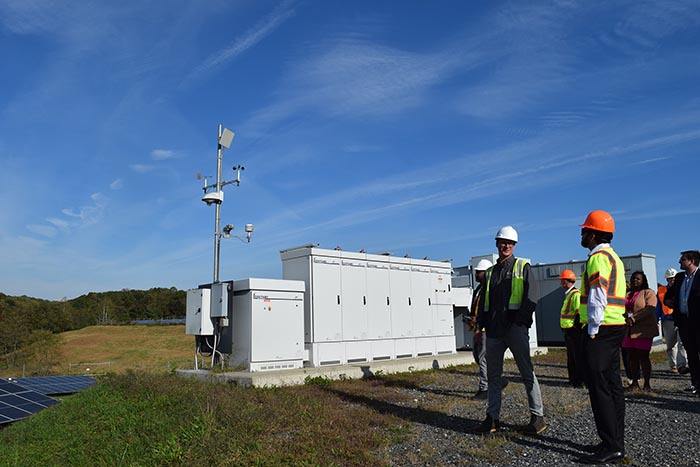


The site opened in June 2018 as a partnership between the City of Annapolis and the energy company Building Energy, with support of the Maryland Department of Natural Resources. Building Energy has since been acquired by Novis Renewable Holdings, which operates the site. The solar arrays now provide energy to Annapolis, Anne Arundel County, and the Anne Arundel County Board of Education.
Thomas Leahy, president of Novis Renewable Holdings, suggested that the site—a repurposed landfill that now generates clean energy and has a positive impact on the environment—is an example of what can be achieved with innovative thinking.
“With sustainability at the core of our activities, it’s a privilege to be part of this project which has transformed an unused and seemingly unusable piece of land into something that we can all be proud of,” Leahy said.
DNR and Annapolis officials point to the project as a model for renewable energy sites in the state.
DNR’s Power Plant Research Program Director Bob Sadzinski said solar projects are critical to meet the state’s renewable energy goals.
“Gov. Moore has positioned Maryland as a leader in green energy with some of the most aggressive renewable energy goals in the nation,” Sadzinski said. “By 2030, Maryland is planning for 50% of our energy to come from renewables, of which 14.5% is expected to come from solar.”
The Power Plant Research Program (PPRP) conducts consolidated environmental reviews of all issues related to power generation and transmission in the state. PPRP aims to allow Maryland to meet electricity demands at a reasonable cost while also considering a variety of environmental and socioeconomic factors, from protecting natural resources and historical sites to promoting environmental justice and job creation.
The Maryland Public Service Commission has granted certificates to proceed for 54 utility-scale solar projects, with eight more projects in progress. Of those approved, 37 are now operational.
Across the state, solar power has a capacity of 1,950 megawatts of electricity, or about 4.3 million megawatt hours of energy annually, with another 882 megawatts projected from new sites that will be built in the next three years, Sadzinski said. That would be enough to power about 429,000 homes every year.
To help developers and officials identify potential locations for future solar and wind projects, PPRP has sponsored an interactive map-based screening tool called SmartDG+, which identifies areas based on proximity to electrical lines, land cover, zoning. and other factors.
PPRP also oversees a program that grants a pollinator-friendly designation to solar facilities. With the decline in bees and other pollinator species in recent decades, solar arrays have been identified as beneficial habitats for pollinators. The program encourages solar sites to use a seed mix of native Maryland wildflowers that can be planted in the open space around arrays. Once the flowers become established, they will attract pollinators.
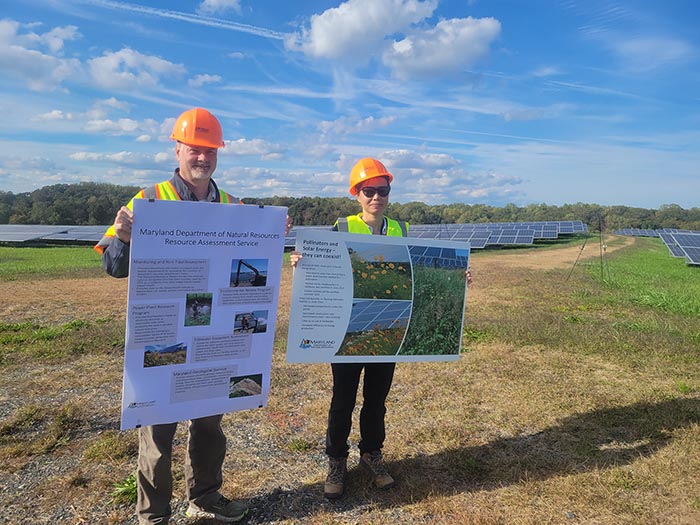

Annapolis officials are hoping to make the former landfill site friendly to pollinators. Guild said the city is also considering adding signage to a trail that adjoins the site to inform residents about the solar panels.
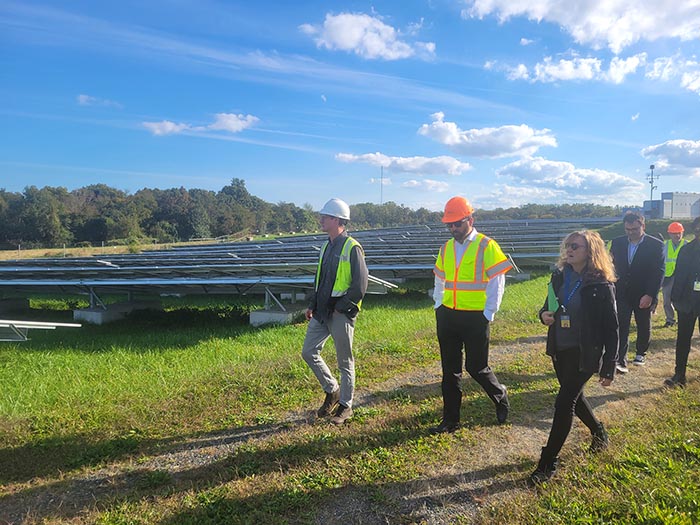
DNR Secretary Josh Kurtz, who joined in the tour of the site during DNR’s Science Week, said he was glad to see a successful solar site on the land and hopes to see more built on brownfield sites.
“We’re really excited to hear more about what’s being done here,” Kurtz said. “We’ve got several brownfields in the state, and they provide an excellent opportunity for development for renewable energy.”

By Joe Zimmermann, science writer with the Maryland Department of Natural Resources.
Why do people believe these solar arrays are green, or even clean? All the thousands of tons of earth moved to harvest the necessary metals to manufacture these huge solar cells is astronomical. And there are countless hazardous/poisonous chemicals used in manufacturing solar cells that cannot be recovered/recycled. The smelter in the Silicon Metal Plant being built in Tennessee to manufacture “Earth Friendly” silica used in solar cells uses enough electricity annually to power 80,000 average homes per year. And the smelter will use annually approximately 170,000 tons of quartzite rock, 150,000 tons of blue gem charcoal and charcoal, and 130,000 tons of of wood-chips per year. Imagine the amount of fossil fuels needed to produce that amount of raw material. The estimated emissions would include hundreds of tons of coal toxins per year. CLEAN ENERGY?? YEAH, RIGHT!!!
Cool, Annapolis and Slo’ Joe are really boosting the economy, of China that is.
Hey! You blamed the president! Good for you!
What a waste of money & time! Keep believing the lie, folks…
“The American Chemical Society has extensively compared solar and fossil fuels, concluding that “Overall, all PV (solar) technologies generate far less life-cycle air emissions per GWh [gigawatt hour] than conventional fossil-fuel-based electricity generation” 11.
Also, the International Renewable Energy Agency and the International Energy Agency Photovoltaic Power System Programme released a joint paper explaining that, on top of far exceeding the energy payback time, over 90% of the materials in current solar panels can be recycled into the next generation 12. As the influence and impact of solar power grow, scientists and manufacturers around the world actively aspire to create even better, more sustainable solar energy technology.”